OpenClaw vs Hermes Agent vs Claude Cowork vs Claude Code vs Codex: What Actually Differs?
A professional deep dive comparing OpenClaw, Hermes Agent, Claude Cowork, Claude Code, and OpenAI Codex across architecture, autonomy, memory, governance, and business use cases.
Posted by
 Jet
JetRelated Reading
Your Team Uses AI. Your Business Still Doesn't.
Why most small businesses remain stuck between AI experiments and operational automation, plus a practical maturity model and 30-day plan for closing the integration gap.
How AI Finds Wasted Ad Spend Before Your Marketing Team Does
A practical AI ad audit playbook for SMBs, SaaS teams, and digital businesses: find wasted spend, diagnose creative fatigue, catch landing page mismatch, and turn ad reports into weekly optimization briefs.
7 AI Automation Tasks for Small Business Owners in 2026
A practical 2026 guide for small business owners: seven repetitive tasks to automate with AI, with workflows, tool stacks, examples, and a 30-day rollout plan.
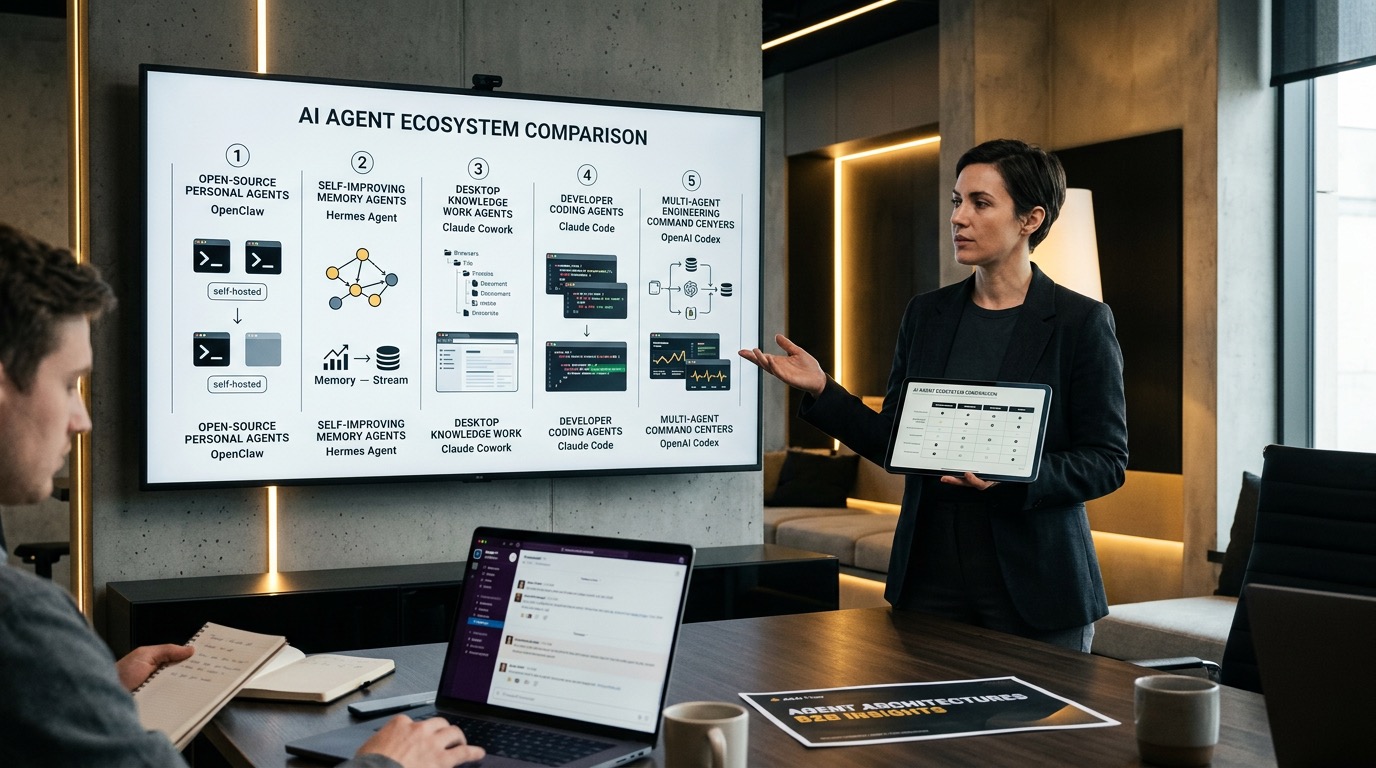
OpenClaw vs Hermes Agent vs Claude Cowork vs Claude Code vs Codex: What Actually Differs?
The AI-agent market is becoming confusing because every product now claims to be a teammate.
OpenClaw says: put an agent where your life and business already happen.
Hermes Agent says: run an agent that learns from experience and grows with you.
Claude Cowork says: give knowledge workers a desktop agent that can complete non-coding tasks.
Claude Code says: give developers an agentic coding environment.
Codex says: give engineering teams a multi-agent command center for building and shipping software.
Those are not small wording differences. They describe different operating models.
If you choose the wrong one, you do not just buy the wrong tool. You shape the wrong workflow. You give the agent the wrong permissions, ask it to do the wrong class of task, and measure it by the wrong metric.
This guide compares the five systems from a practical enterprise perspective: where they run, what they are good at, how much autonomy they assume, how they handle memory, and what kind of company should deploy each one.
The short version
If you only remember one thing, remember this:
OpenClaw and Hermes Agent are agent runtimes. Claude Cowork is a knowledge-work agent surface. Claude Code and Codex are engineering agents.
That distinction matters more than model quality.
| Tool | Best mental model | Primary user | Core environment | Main strength | Main risk |
|---|---|---|---|---|---|
| OpenClaw | Personal/team operating agent | Operators, founders, power users | Self-hosted or local, connected to chat channels and tools | Ambient automation across Slack, Telegram, Discord, email, files, browsers, and custom skills | Governance and security are largely your responsibility |
| Hermes Agent | Self-improving personal agent | Builders who want memory and model freedom | CLI/cloud/VPS/serverless plus chat gateways | Built-in learning loop, skill creation, long-term personalization, model agnosticism | Operational maturity and enterprise controls depend on your setup |
| Claude Cowork | Desktop coworker for knowledge work | Non-technical professionals | Claude Desktop app, files, apps, browser/computer use | Makes agentic work usable without terminal skills | Research-preview style boundaries; not suitable for regulated workloads according to Anthropic |
| Claude Code | Developer agent workspace | Engineers and technical teams | CLI, desktop Code tab, local/remote/SSH sessions | Deep codebase work, diffs, tests, previews, connectors, plugins, subagents | Needs engineering workflow discipline and permission hygiene |
| Codex | Multi-agent engineering command center | Engineering teams and technical operators | Codex app, CLI, IDE extension, web, cloud environments | Parallel agents, worktrees, end-to-end software tasks, PR-oriented work | Code-first; broader knowledge work should still be designed carefully |
The decision is not "which is best?" The decision is "which layer of work are you trying to agentize?"
A better taxonomy: five layers of agent work
Most comparisons put all AI agents in one bucket. That is the first mistake.
There are at least five separate layers:
- Channel agents live inside Slack, Telegram, Discord, WhatsApp, email, or other conversational surfaces. They are useful because people can delegate work without opening a special app.
- Memory agents improve over time by retaining context, turning experience into skills, and developing a persistent model of the user or organization.
- Desktop agents operate through files, folders, browsers, and apps. They are closer to a digital coworker than a chatbot.
- Coding agents understand repositories, tests, terminals, diffs, branches, and engineering constraints.
- Agent command centers coordinate many long-running agents across worktrees, projects, cloud environments, and approvals.
OpenClaw is strongest at layer 1 and can reach into layers 2-4 through plugins and integrations.
Hermes Agent is strongest at layer 2.
Claude Cowork is strongest at layer 3.
Claude Code is strongest at layer 4.
Codex is strongest at layer 5, while also being very capable at layer 4.
This taxonomy immediately clarifies the product landscape. The tools overlap, but they do not start from the same assumption.
OpenClaw: the agent as an operating layer
OpenClaw is best understood as an open-source, self-hostable agent platform that puts AI into the communication channels and systems where work already happens.
The official OpenClaw site highlights real-world patterns like email cleanup, deck review, Google Ads optimization, daily briefings, calendar conflict resolution, invoice creation, voice-guided production fixes, and orchestrating Codex workers from Discord. Its docs showcase community examples across Telegram feedback loops, browser automation, skills, Slack support, hardware control, personal memory, and multi-agent orchestration (OpenClaw, OpenClaw showcase).
That tells you the product philosophy: OpenClaw is not primarily a polished SaaS app. It is an agent substrate.
Its natural home is a company that wants an AI teammate reachable from Slack or Telegram, able to call tools, read context, coordinate other agents, and handle messy operational work.
OpenClaw is especially strong when:
- The task begins in a chat channel.
- The output spans several tools.
- You want self-hosting or local control.
- You want to wire together custom skills.
- You want one agent interface across personal, operational, and technical workflows.
For example, an operations team could use OpenClaw as a Slack-based internal teammate:
- Summarize a customer escalation thread.
- Create a Linear issue.
- Pull the latest account context.
- Draft a reply.
- Ask Codex or Claude Code to inspect a bug.
- Return a status update in Slack.
The strength is breadth.
The weakness is governance.
OpenClaw gives you a lot of rope because it is designed to touch real systems. In a company, that means you need explicit permission boundaries, audit logs, secrets management, sandboxing, and human approval gates. Without those, the same flexibility that makes OpenClaw powerful also makes it risky.
Best fit: technical SMBs, AI-forward operators, founders, internal automation teams, and companies comfortable owning infrastructure.
Poor fit: regulated teams that need turnkey enterprise governance before experimentation.
Hermes Agent: the agent that learns
Hermes Agent, built by Nous Research, is positioned as a self-improving AI agent. Its GitHub README describes a built-in learning loop: it creates skills from experience, improves them during use, nudges itself to persist knowledge, searches past conversations, and builds a deeper model of the user across sessions. It also emphasizes model freedom: Nous Portal, OpenRouter, NVIDIA NIM, OpenAI, Anthropic, Hugging Face, and custom endpoints are all framed as interchangeable backends (Hermes Agent GitHub).
This makes Hermes different from OpenClaw in an important way.
OpenClaw is about where the agent lives and what it can connect to.
Hermes is about how the agent adapts over time.
That learning loop matters because many agent failures are not reasoning failures. They are context failures. The agent does not know your style, your past decisions, your preferred workflows, your recurring projects, or which corrections should become durable behavior.
Hermes tries to make that durability first-class.
It is strongest when:
- You want persistent personalization.
- You want model-provider independence.
- You want an agent running away from your laptop, such as on a VPS or cloud VM.
- You want skills to emerge from repeated work.
- You are willing to operate an open-source stack.
In a business context, Hermes is attractive for roles where repeated context matters:
- Founder assistant with long-term memory.
- Research agent that remembers sources, preferences, and judgment criteria.
- Personal ops agent that learns recurring routines.
- Internal chief-of-staff style assistant.
- Support or success assistant that improves with repeated corrections.
The tradeoff is that self-improvement is not automatically enterprise-safe.
An agent that writes memories, creates skills, and adapts behavior needs review. You need to know what it learned, why it learned it, and whether the new behavior should apply to one user, one team, or the whole company.
Best fit: power users, technical founders, AI labs, advanced operators, and teams experimenting with durable agent memory.
Poor fit: companies that want a controlled, admin-managed knowledge-work agent with minimal setup.
Claude Cowork: Claude Code for non-coding work
Claude Cowork is Anthropic's attempt to bring agentic execution to mainstream knowledge work.
Anthropic describes Cowork as an agentic AI system for knowledge work that runs on desktop, connects to local files and applications, and completes multi-step tasks from start to finish. The user defines the goal; Cowork figures out the path. Anthropic also explicitly distinguishes it from Claude Code: Claude Code is a command-line developer tool, while Cowork brings the same agentic architecture into the desktop app for non-coding knowledge work, with no terminal required (Claude Cowork).
This is the key: Claude Cowork is about accessibility.
It is for people who should not have to understand shells, repos, MCP config, worktrees, or pull requests in order to delegate meaningful work.
Good Cowork tasks look like:
- "Read these five docs and create a client-ready summary."
- "Clean this spreadsheet and make a one-page analysis."
- "Turn this folder of notes into a structured proposal."
- "Prepare a briefing from these files and recent web research."
- "Use the browser to collect information and return a report."
Cowork is not trying to be the most flexible open-source runtime. It is trying to package agentic work inside a trusted desktop experience.
That makes it promising for finance, sales, consulting, recruiting, marketing, legal ops, and executive support teams, with one major caveat: Anthropic states that Cowork is not suitable for HIPAA, FedRAMP, or FSI regulated workloads (Claude Cowork).
Best fit: non-technical knowledge workers who need file, browser, and app automation in a managed desktop environment.
Poor fit: teams that need self-hosting, deep customization, or regulated workload guarantees.
Claude Code: the developer agent workspace
Claude Code is not just "Claude in a terminal." It is an agentic development environment.
The Claude Code Desktop docs describe sessions with their own chat history, project folder, and code changes; parallel sessions; diff review; app previews; terminal and file panes; side chats; connectors to services like GitHub, Slack, and Linear; local, remote, and SSH environments; subagents; plugins; skills; and recurring work patterns (Claude Code Desktop docs).
That architecture reveals what Claude Code is optimized for:
- Understand the repository.
- Modify files.
- Run commands and tests.
- Inspect failures.
- Produce diffs.
- Iterate with the developer.
- Open or monitor PRs.
- Use connectors and MCP servers when needed.
Claude Code is strongest when the work product is code or code-adjacent:
- Build a feature.
- Fix a regression.
- Migrate an API.
- Update dependencies.
- Add tests.
- Refactor a module.
- Investigate CI failure.
- Create internal developer tooling.
- Connect a codebase to an external service.
For technical teams, the difference between Claude Code and Claude Cowork is not model intelligence. It is workflow ergonomics.
Cowork asks: how can an office worker delegate a multi-step desktop task?
Claude Code asks: how can a developer delegate a repository task while preserving the engineering loop of diff, test, review, and merge?
Best fit: developers, technical founders, platform teams, and companies where software changes are the core bottleneck.
Poor fit: non-technical employees who need document, spreadsheet, or browser work but do not want developer tooling.
Codex: the engineering command center
OpenAI's Codex is also a coding agent, but its strategic emphasis is slightly different from Claude Code.
OpenAI positions Codex as a coding agent that helps teams build and ship with AI. The official Codex page emphasizes end-to-end engineering tasks such as features, refactors, migrations, and routine pull requests. It also describes the Codex app as a command center for agentic coding, with built-in worktrees and cloud environments so agents can work in parallel across projects (OpenAI Codex).
OpenAI's Help Center describes Codex as an AI agent for writing, reviewing, and shipping code, available through the Codex app, CLI, IDE extension, and web, with enterprise setup, plugins, app controls, and RBAC options for business users (OpenAI Help Center).
The key phrase is command center.
Codex is not only about one agent helping one developer. It is about coordinating multiple agents over longer-running tasks, often in parallel.
That makes it particularly strong for:
- Multi-repo engineering programs.
- Parallel feature work.
- Maintenance backlogs.
- CI failure triage.
- Codebase modernization.
- Migration projects.
- Automated review and implementation loops.
- Engineering teams that want agent work isolated in worktrees and cloud environments.
Compared with Claude Code, Codex feels more explicitly oriented toward agent management at team scale.
Claude Code feels like a deeply integrated developer cockpit.
Codex feels like an engineering operations layer for many agents.
That distinction is not absolute, and both products are moving quickly. But it is useful when selecting a primary workflow.
Best fit: engineering teams that want parallel agent work, PR throughput, cloud environments, and centralized coordination.
Poor fit: broad non-technical business automation where the primary surface is Slack, desktop files, or personal memory rather than code.
The real comparison: architecture, not features
Feature lists age quickly. Architecture lasts longer.
Here is the more durable comparison.
| Dimension | OpenClaw | Hermes Agent | Claude Cowork | Claude Code | Codex |
|---|---|---|---|---|---|
| Default surface | Chat channels, CLI, gateways | CLI, chat gateways, cloud/VPS | Claude Desktop | CLI/Desktop Code tab | Codex app, CLI, IDE, web |
| Primary job | Operate across tools and channels | Learn and improve over time | Complete knowledge-work tasks | Change codebases safely | Coordinate coding agents |
| Best autonomy pattern | User delegates from chat; agent calls tools | Agent accumulates reusable knowledge and skills | User gives goal; desktop agent executes | Developer delegates repo task; reviews diff | Team dispatches parallel agent tasks |
| Memory model | Depends on setup, skills, and integrations | First-class learning loop | Product-managed context | Session/project context, skills/plugins | Workspace/project/task context |
| Integration model | Open-source skills, gateways, custom tools | Model-agnostic providers and gateways | Desktop files/apps/browser/connectors | MCP/connectors/plugins/skills | Plugins, GitHub, cloud environments, worktrees |
| Governance model | DIY unless layered with enterprise controls | DIY unless layered with controls | Anthropic-managed product boundaries | Developer approvals and org configuration | OpenAI workspace controls, plugins, RBAC for business |
| Best buyer | Technical operators | Memory/agent builders | Knowledge-work teams | Engineering teams | Engineering orgs |
This is why simplistic claims like "OpenClaw is better than Codex" or "Claude Code replaces Cowork" are not useful.
They answer different questions.
Which one should a company use?
Use OpenClaw if your bottleneck is operational delegation across channels.
If your team lives in Slack and you want an AI teammate that can summarize threads, call tools, create issues, coordinate other agents, and work across messaging surfaces, OpenClaw is the most natural fit. It is especially compelling when you want ownership and customization.
Use Hermes Agent if your bottleneck is persistent context.
If you want an agent that grows with the user, builds skills from repeated work, and can run on flexible infrastructure with model choice, Hermes is the most interesting option. It is less about polished enterprise UI and more about long-term adaptive behavior.
Use Claude Cowork if your bottleneck is everyday knowledge work.
If the users are consultants, analysts, sales reps, operators, recruiters, or executives who need files, browser work, summaries, proposals, and research handled inside a desktop app, Cowork is the cleanest fit.
Use Claude Code if your bottleneck is developer throughput inside a repository.
If engineers need an agent that understands code, runs commands, tests changes, manages diffs, and plugs into development tools, Claude Code is built for that loop.
Use Codex if your bottleneck is engineering scale.
If you want multiple coding agents working in parallel across worktrees, projects, and cloud environments, Codex is designed as a command center for agentic engineering.
The most powerful setup is often a stack
The more mature answer is not choosing one tool.
It is assigning tools to the right layer.
A strong AI-forward company might run:
- OpenClaw in Slack as the company-facing delegation layer.
- Hermes Agent for persistent personal memory and adaptive workflows.
- Claude Cowork for non-technical desktop knowledge work.
- Claude Code for developer sessions where engineers want tight repository control.
- Codex for parallel engineering work and agent orchestration across projects.
In that setup, OpenClaw can become the front door.
An employee asks in Slack:
@OpenClaw summarize this customer issue, check whether it looks like a product bug, and route it to the right owner.
OpenClaw summarizes the context, checks customer history, creates a Linear issue, and if the issue looks technical, dispatches the right work to Claude Code or Codex. Hermes-like memory can preserve what the organization learned from the incident. Cowork can later produce a customer-facing postmortem or internal account brief.
That is not science fiction. It is simply using each agent at the layer where it is strongest.
Governance: the part everyone underestimates
The more agentic the system, the more governance matters.
Before deploying any of these tools broadly, define five policies:
- Permission tiers. What can the agent read, draft, modify, send, delete, purchase, or deploy?
- Human approval gates. Which actions always require approval?
- Auditability. Where are prompts, tool calls, file changes, and approvals logged?
- Memory scope. What may be remembered, who can edit it, and when should it expire?
- Secrets and regulated data. Which systems and workloads are out of bounds?
This is especially important for OpenClaw and Hermes because their open, customizable nature can exceed the governance maturity of the company using them.
It is also important for Claude Code and Codex because code changes can affect production systems, customer data, and security posture.
For Claude Cowork, pay close attention to Anthropic's stated regulated-workload limitations before rolling it out to sensitive teams.
The bottom line
OpenClaw, Hermes Agent, Claude Cowork, Claude Code, and Codex are not five versions of the same product.
They are five answers to five different questions:
- OpenClaw: How do we put an agent into the channels where work already happens?
- Hermes Agent: How do we make an agent learn and improve with the user?
- Claude Cowork: How do we make agentic execution usable for non-technical knowledge workers?
- Claude Code: How do we make an agent productive inside a developer's codebase?
- Codex: How do we coordinate many coding agents to ship more software?
For most businesses, the winning strategy is not to crown a single winner. It is to map work into layers, then choose the agent surface that matches each layer.
Use OpenClaw for delegation.
Use Hermes for memory.
Use Cowork for knowledge work.
Use Claude Code for developer flow.
Use Codex for engineering scale.
That is the professional way to think about the agent stack in 2026.