Your Next Hire Might Be a $100/Day AI Teammate in Slack
How companies can use OpenClaw as a Slack-native AI teammate to absorb temporary busywork, help employees focus, improve performance, and compound into a smarter operating system.
Posted by
 Jet
JetRelated Reading
Your Team Uses AI. Your Business Still Doesn't.
Why most small businesses remain stuck between AI experiments and operational automation, plus a practical maturity model and 30-day plan for closing the integration gap.
How AI Finds Wasted Ad Spend Before Your Marketing Team Does
A practical AI ad audit playbook for SMBs, SaaS teams, and digital businesses: find wasted spend, diagnose creative fatigue, catch landing page mismatch, and turn ad reports into weekly optimization briefs.
7 AI Automation Tasks for Small Business Owners in 2026
A practical 2026 guide for small business owners: seven repetitive tasks to automate with AI, with workflows, tool stacks, examples, and a 30-day rollout plan.
Your Next Hire Might Be a $100/Day AI Teammate in Slack
Most companies do not have a people problem.
They have a tiny-task problem.
Someone needs to summarize a long thread. Someone needs to turn call notes into a follow-up email. Someone needs to find the latest pricing page, pull the top three competitor claims, clean a spreadsheet, draft an onboarding checklist, prepare a meeting brief, update a CRM field, or chase a decision that should have happened yesterday.
None of these tasks is large enough to justify hiring a full-time person.
But together, they quietly eat your team.
They break focus. They create context switching. They make strong employees spend the best hours of their day on work that requires attention, but not judgment. By the time they get back to strategy, product, sales, customer thinking, or creative work, their brain has already paid the tax.
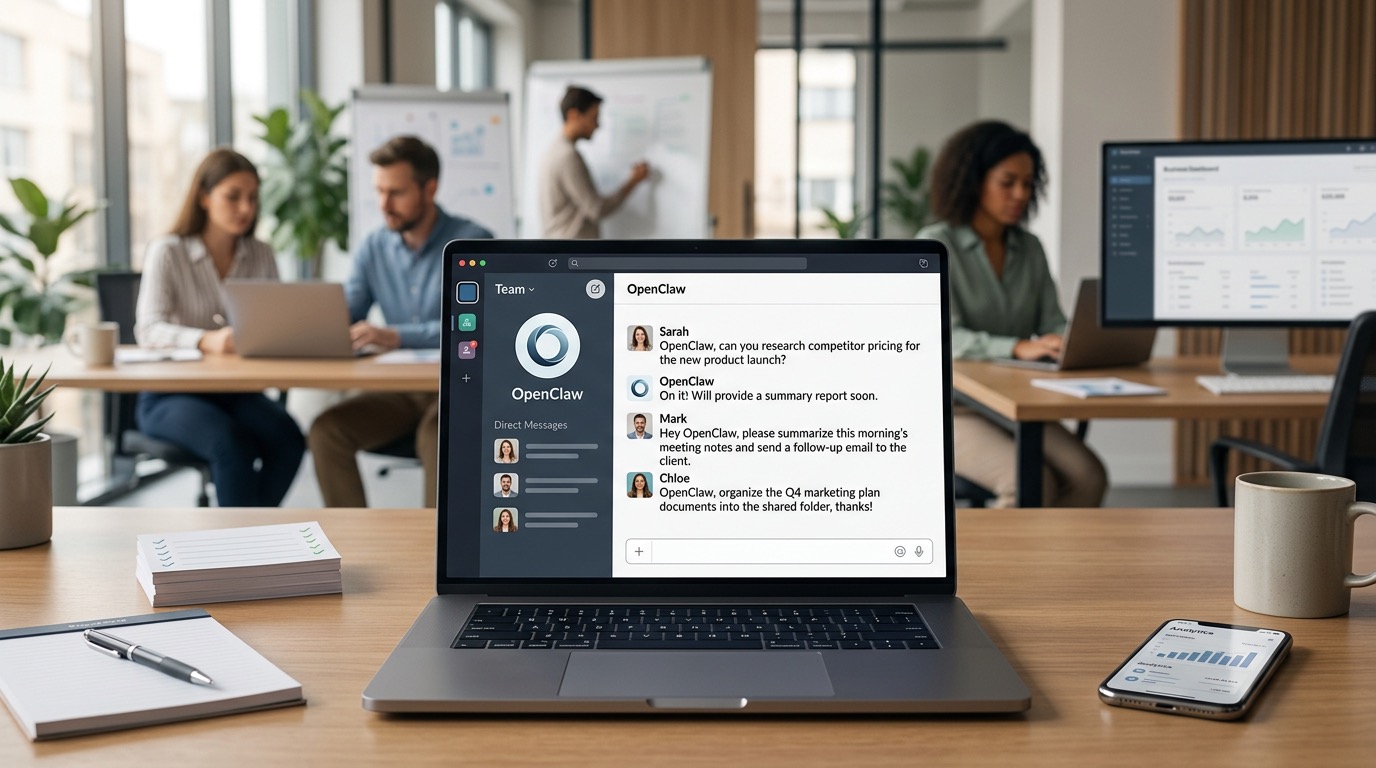
This is where OpenClaw becomes interesting: not as "software," and not as another AI chat box, but as a Slack-native AI teammate that your whole company can use like a real team member.
At roughly $100/day, it is not cheap. That is about $3,000/month, which will make a practical founder pause. But if it removes even a fraction of the temporary, scattered, low-judgment work across a 10-20 person company, the value can easily exceed $30,000/month.
The point is not to replace your best employees.
The point is to stop wasting them.
The employee you do not need to hire
Every growing company eventually reaches a strange operational zone.
There is too much work for the existing team, but not enough of any one type of work to justify a clean hire.
You do not need a full-time researcher. You need research 12 times a week.
You do not need a full-time copywriter. You need 40 drafts, rewrites, summaries, and follow-ups.
You do not need a full-time analyst. You need someone to look at messy context, find the signal, and turn it into a decision memo.
You do not need another coordinator. You need hundreds of tiny operational nudges to stop falling through the cracks.
Traditionally, companies handle this in three bad ways:
- They overload high-performing employees with "quick asks."
- They hire temporary contractors who need management and context.
- They let the work disappear until it becomes urgent.
OpenClaw offers a fourth option: add an AI teammate into Slack and let the company route these temporary tasks to it as they appear.
That difference matters. Most AI tools require employees to leave the flow of work, open a separate interface, paste context, explain the task, copy the result back, and then remember where they were.
A Slack teammate sits where the work already happens.
If the team can mention @OpenClaw in a channel, DM it, add it to a project room, or assign it a recurring workflow, the friction drops close to zero. That is when usage becomes normal. And normal usage is where ROI lives.
What OpenClaw should absorb first
Do not begin with the most important work in the company. Begin with the most repeated work that interrupts important work.
The first OpenClaw workflows should be boring, frequent, and easy to review:
- Summarize long Slack threads into decisions, blockers, and next actions.
- Turn meeting notes into a follow-up email and task list.
- Draft first versions of customer replies, internal announcements, and partner updates.
- Research a company, contact, market, tool, or competitor before a call.
- Convert rough thoughts into structured memos.
- Prepare project status updates from channel history and linked docs.
- Create checklists for onboarding, launches, QA, handoffs, and postmortems.
- Compare options and produce a recommendation with tradeoffs.
- Remind the right people when a task is stuck.
None of this requires OpenClaw to be magical.
It only needs to be consistently useful, fast, and available.
Think about the economics. If 12 employees each save 30 minutes per day, that is 6 team-hours saved daily. At a blended fully loaded cost of $80/hour, that is $480/day in recovered capacity before you count the deeper value: fewer broken focus blocks, faster decisions, better follow-through, and more mental space for real thinking.
That already beats $100/day.
But the larger return is not time saved. It is throughput unlocked.
Your sales person can enter a call with a sharper brief. Your founder can turn a messy idea into a strategy note in 10 minutes. Your ops lead can see blockers before they become drama. Your marketer can create five solid draft angles before lunch. Your customer success team can respond with more context and less fatigue.
That is where the $30,000/month value starts to become believable.
The Slack-native model changes adoption
Companies have tried AI rollouts before. Usually they fail for a simple reason: the tool lives somewhere else.
The founder buys seats. A few power users get value. Everyone else uses it twice, forgets, and returns to old habits.
Slack-native OpenClaw is different because the interface is already social.
People do not need to remember a workflow. They can ask in plain language:
@OpenClaw summarize this thread and tell us what still needs a decision.
@OpenClaw turn these notes into a customer follow-up in our normal tone.
@OpenClaw research this prospect and give me a 5-minute call brief.
@OpenClaw compare these three tools and recommend the simplest option for a 12-person team.
Even better, the rest of the team can see the interaction. That creates shared learning.
One employee asks for a useful output. Another sees the pattern and reuses it. A manager improves the prompt. A founder turns the best version into a repeatable playbook.
This is how an AI teammate becomes part of culture instead of another unused subscription.
It helps employees focus and perform better
There is a subtle but important framing here.
If you introduce OpenClaw as "AI replacing people," employees will resist it, often for good reasons. Nobody wants to train the system that management will use against them.
If you introduce OpenClaw as "the teammate that takes low-leverage work off your plate," the conversation changes.
The promise to the team should be direct:
- Use OpenClaw before you spend 45 minutes cleaning up something messy.
- Use OpenClaw before you write from a blank page.
- Use OpenClaw before you manually summarize context that already exists.
- Use OpenClaw when you need a second brain to think through tradeoffs.
- Use OpenClaw when a task is important enough to do, but not important enough to steal your deep work.
This is not just productivity theater. Focus is expensive. Every interruption carries a recovery cost. Every small administrative task forces the brain to reload context. When a team spends all day bouncing between small asks, performance drops even if everyone looks busy.
OpenClaw gives the company a pressure valve.
Employees can delegate the first pass, the cleanup, the synthesis, the formatting, the research, the options list, the status draft. Humans still decide. Humans still own judgment. Humans still carry relationships.
But they stop doing the mechanical parts alone.
It also helps leadership think better
The most underrated use case is not task completion. It is thinking.
A good AI teammate can help a founder or manager turn scattered context into clearer decisions:
- "What are the hidden assumptions in this plan?"
- "What would break if we doubled volume next month?"
- "Summarize the risks from the last three customer calls."
- "Turn this messy Slack discussion into a decision memo."
- "What are the three strongest arguments against my current strategy?"
For leadership, this is incredibly valuable because the bottleneck is rarely typing speed. The bottleneck is clarity.
OpenClaw can be the always-available thinking partner that does not care if the first draft is messy. It can reflect, organize, challenge, compress, and expand. It can help a team move from scattered conversations to actual decisions.
That is where a $100/day tool can become a serious operating advantage.
The teammate gets better over time
A human employee improves through context, feedback, and repetition.
An AI teammate can improve the same way if you treat it like part of the operating system instead of a disposable chatbot.
The company should build a shared OpenClaw playbook:
- Company positioning, ICP, offers, and common objections.
- Brand voice rules and examples of good writing.
- Standard operating procedures for recurring tasks.
- Decision principles: what the company optimizes for, avoids, and escalates.
- Examples of great outputs and corrected bad outputs.
- Channel-specific rules for sales, ops, support, marketing, and product.
Every time someone improves a prompt, adds context, or corrects a weak output, the system gets better for everyone.
That compounding is the real unlock.
With a contractor, learning often stays inside one person's head. With an AI teammate, the learning can become shared infrastructure. Your team does not just use OpenClaw. Your team trains the company's way of working into OpenClaw.
Over time, it becomes less like a generic assistant and more like an internal operating layer.
A practical 7-day rollout
Do not over-engineer the launch. A small, disciplined rollout beats a big announcement.
Day 1: Add OpenClaw to Slack. Put it in a few high-signal channels: leadership, sales, customer success, ops, and one project channel. Tell the team exactly what to use it for first.
Day 2: Pick 10 recurring tasks. Choose tasks that are frequent, annoying, and easy for a human to review. Avoid high-risk approvals, legal commitments, hiring decisions, financial transfers, or anything that should never be automated casually.
Day 3: Create the first prompt library. Write simple examples: summarize a thread, draft a follow-up, research a prospect, compare tools, prepare a meeting brief, turn notes into tasks.
Day 4: Run a live internal demo. Do not show slides. Use real Slack threads and real tasks. Let employees see the tool save time in the environment they already use.
Day 5: Assign one owner. Someone must maintain the prompt library, collect examples, update instructions, and watch failure patterns. This is a lightweight role, but it matters.
Day 6: Add recurring workflows. Daily digest, stuck-task summary, weekly customer insight brief, sales call prep, project status summary.
Day 7: Review usage and savings. Ask: which tasks did OpenClaw handle well, where did it fail, and which workflows should become standard?
By the end of one week, OpenClaw should have a clear job: absorb scattered temporary work so the human team can focus.
The operating rule: AI drafts, humans decide
The fastest way to ruin trust is to let AI take actions that should require human judgment.
Set the rule early:
OpenClaw drafts, summarizes, researches, structures, compares, reminds, and prepares. Humans approve, send, commit, spend, hire, fire, and decide.
That boundary keeps the system useful without making it reckless.
You can loosen permissions later, after the team has evidence. But in the beginning, the goal is adoption and trust.
The best version of this is not "AI runs the company."
The best version is "AI removes the fog around the company so people can run it better."
Why $100/day is cheaper than it feels
The sticker shock is real.
$100/day sounds expensive because most software is priced like a tool. But OpenClaw should be evaluated like a flexible teammate.
A $3,000/month AI teammate that works across departments is not competing with a $20/month chatbot. It is competing with:
- The part-time assistant you almost hired.
- The junior operator who would need onboarding.
- The contractor who does not know your context.
- The lost output from employees doing low-leverage work.
- The decisions delayed because nobody had time to prepare the brief.
If OpenClaw saves 15-20 hours per week across the company, the time math works.
If it improves sales prep, customer follow-up, internal execution, and leadership clarity, the business math can become much larger.
And if it becomes part of how the whole company thinks, writes, researches, and follows through, the monthly value can easily exceed $30,000.
That is the real bet.
Not that AI is cheap.
That focus is expensive.
The bottom line
Companies do not need more busy people. They need more focused people.
OpenClaw can become the shared AI teammate that catches the temporary, scattered, annoying, high-friction work that normally falls onto your best employees.
Put it in Slack. Let everyone use it. Start with the tasks that interrupt focus. Build a shared playbook. Improve it every week.
At $100/day, it should be held to a high standard.
But if it gives your team back their attention, improves the quality of their thinking, and compounds into a smarter company operating system, the price is not the story.
The story is what your people can finally do when the tiny-task problem stops owning their day.